
Discover What Your Customers Really Want to Achieve
Jobs-to-be-Done (JTBD) is a powerful framework that helps you understand the underlying motivations behind customers’ purchasing decisions and product usage. Instead of focusing on demographic characteristics or product features, JTBD is about discovering which “jobs” customers “hire” your product to perform in their lives.

Why Jobs-to-be-Done interviews?
Traditional customer interviews often focus on superficial preferences or feature requests. JTBD interviews go deeper to uncover:
- The real reasons behind purchase decisions
- Emotional and social drivers, not just functional needs
- Competition from unexpected alternatives and solutions
- The context in which the product is used and value is created
- Obstacles that prevent customers from “hiring” your product
When should you use this interview template?
- When you want to understand why customers choose (or don’t choose) your product
- When you’re developing new products or features
- When you want to improve your marketing and communication
- When you need to differentiate your product from competitors
- When you want to identify new market opportunities
Interview Preparation
1. Identify the right interview subjects
Focus on people who have recently:
- Purchased your product or service
- Switched from a competitor to your solution
- Considered your product but chose something else
- Stopped using your product
2. Create the right environment
- Plan for 45-60 minutes per interview
- Choose a quiet and comfortable location (physical or digital)
- Ask for permission to record the conversation
- If you are not recording the interview, have at least two people present: one interviewer and one note-taker
- Prepare compensation for the interviewee’s time if appropriate (e.g. a cinema voucher!)
3. Prepare your interview team
- Briefing on the JTBD framework for everyone involved
- Review of the interview guide and role allocation
- Prepare tools for documentation and analysis
Interview Structure
Part 1: Introduction and Warm-Up (5-10 min)
Purpose: Build trust and set the context for the conversation. Key Questions:
- Thank you for taking the time. Can you tell me a bit about yourself?
- We are interested in understanding how people choose and use [product category]. There are no right or wrong answers.
- Can you talk about your role/daily life related to [relevant context]?
Tip: Avoid mentioning specific products or brands at the start to avoid influencing responses.
Part 2: Discover the Purchase Journey (15-20 min)
Purpose: Understand the whole process from the first thought to the purchase decision. Key Questions:
- When did you first start considering getting a [product category]?
- What happened in your life that made you start looking for a solution?
- Tell me about the specific situation that made you realize you needed to make a change.
- What was your daily life like before you got [the product]?
- What alternatives did you consider?
- How did you search for information about different options?
- What was decisive for your final decision?
Deepening Questions:
- “Tell me more about that…”
- “How did it feel when…?”
- “Why was it important to you?”
- “What did you hope would be different?”
Part 3: Identify the “Job” (15-20 min)
Purpose: Understand the functional, emotional, and social dimensions of the “job.” Key Questions:
- What were you actually trying to achieve when you bought [the product]?
- If [the product] were a person you hired, what job description would it have?
- What problems did you expect [the product] to solve for you?
- How did you hope your life would change after the purchase?
- What concerns or fears did you have before the purchase?
Dimensions to Explore:
- Functional Aspects: “What practical problems does the product solve?”
- Emotional Aspects: “How did you want to feel after using the product?”
- Social Aspects: “How does the product affect how others see you or how you interact with others?”
Part 4: Evaluate the Outcome (10-15 min)
Purpose: Understand how well the product performs the “job” and identify areas for improvement. Key Questions:
- How well has [the product] met your expectations?
- Which parts of the “job” does the product perform well?
- Which parts of the “job” does the product perform less well?
- Have you needed to supplement with other solutions? Which ones?
- If you could change anything about the product, what would it be?
- Have you recommended the product to others? Why/why not?
Part 5: Conclusion (5 min)
Purpose: Summarize and conclude on a positive note. Key Questions:
- Is there anything else you think about regarding your choice and use of [the product] that we haven’t discussed?
- If you were to give advice to someone considering buying a similar product, what would it be?
- Thank you for your time. May we contact you again if we have follow-up questions?
Analysis Techniques for JTBD Interviews
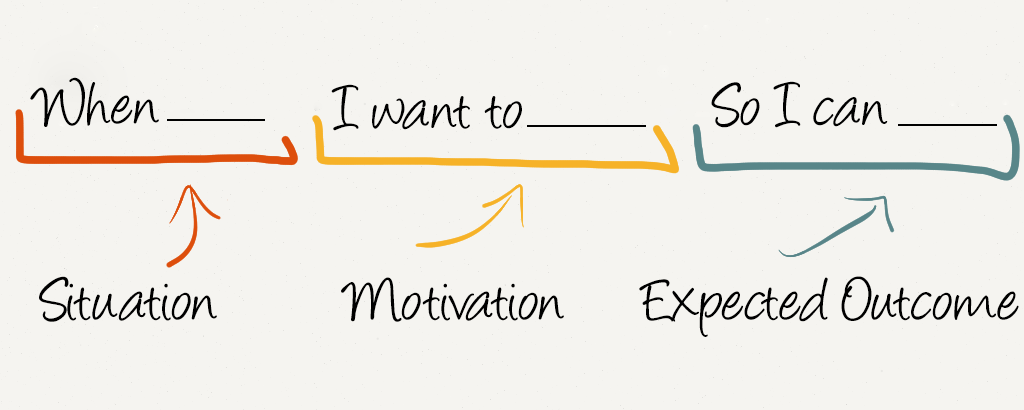
1. Identify Job Statement
Structure the customer’s “job” in the format: “When I [context], I want to [motivation], so that I can [desired outcome].” Example: “When I work from home, I want to easily switch between tasks, so that I can be productive without feeling overwhelmed.”
2. Create a “Push-Pull-Anxiety-Habit” Analysis
For each interview, identify:
- Push Factors: What made the customer abandon their current solution?
- Pull Factors: What made your solution attractive?
- Anxiety/Concerns: What fears did the customer have about the switch?
- Habits: What existing behaviors influenced the decision?
3. Map Competition
Identify all alternatives the customer considered, including:
- Direct competitors
- Indirect competitors
- “Do nothing”
- Manual or homemade solutions
4. Identify Progress Indicators
What does the customer see as signs of success when using the product?
- Functional measures
- Emotional measures
- Social measures
Common Mistakes to Avoid
- Leading Questions Avoid questions like: “Would you say our product saves you time?” Better: “How has your daily life changed since you started using the product?”
- Focus on Hypothetical Scenarios Avoid: “Would you use a feature that…” Better: “Tell me about the last time you tried to…”
- Premature Focus on Solutions Avoid discussing specific features before understanding the core “job.”
- Ignoring Emotional and Social Aspects Ensure to explore all dimensions of the “job,” not just the functional ones.
- Insufficient Documentation Record the interviews (with permission) and take detailed notes.
Next Steps
After conducting JTBD interviews, consider these tools for continued development:
- Empathy Map Canvas - To visualize customer insights
- Value Proposition Canvas - To connect customers’ “jobs” to your offering
- Customer Journey Map - To map the entire customer experience
Download JTBD Interview Template
Resources for Further Study
Books
- “Competing Against Luck” by Clayton Christensen
- “Jobs to be Done: Theory to Practice” by Anthony Ulwick
- “The Jobs To Be Done Playbook” by Jim Kalbach
Articles and Guides
Videos


Var det här verktyget hjälpfullt?