
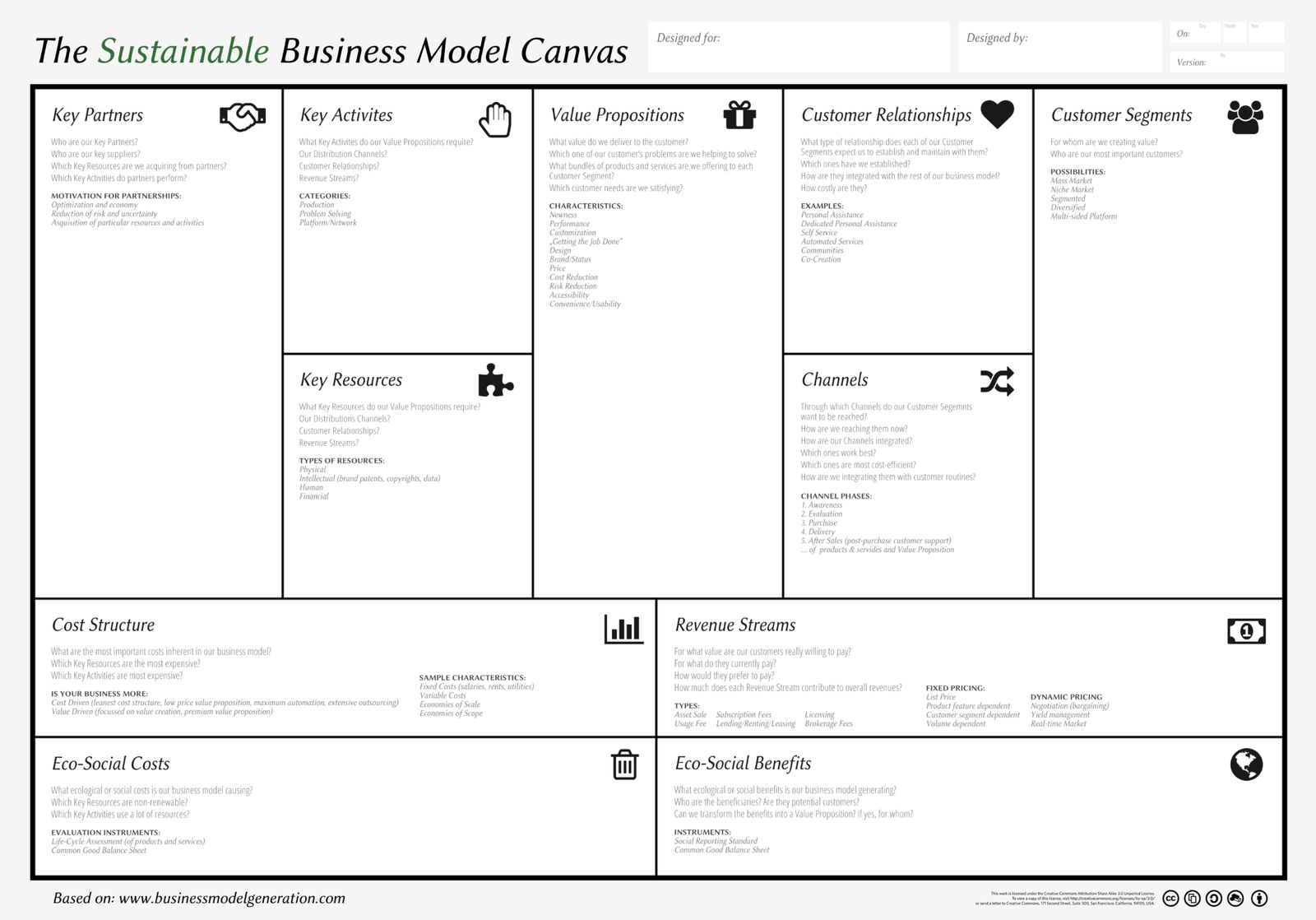
The Sustainable Business Model Canvas (SBMC) extends the traditional Business Model Canvas by integrating environmental and social impacts directly into your business model design. Instead of treating sustainability as a separate concern, it makes eco-social costs and benefits visible alongside financial considerations.
What Makes It Different from the Standard BMC
The standard Business Model Canvas focuses primarily on economic value - how you create, deliver, and capture financial value. It has nine building blocks but doesn’t explicitly address environmental or social impact.
The Sustainable Business Model Canvas adds two critical sections:
Eco-Social Costs - What negative environmental and social impacts does your business model create? Carbon emissions, resource depletion, waste generation, negative labor practices, or harmful social effects.
Eco-Social Benefits - What positive environmental and social value does your business generate? Reduced emissions, circular resource use, improved wellbeing, job creation, or community development.
These additions force you to consider the full impact of your business model, not just the financial bottom line.
The Complete Structure
Top Section (Same as Standard BMC)
Key Partners - Who helps you create value? Suppliers, distributors, strategic alliances. In SBMC, you also consider their sustainability practices.
Key Activities - What critical actions create your value proposition? In SBMC, assess the environmental and social impact of each activity.
Key Resources - What assets do you need? In SBMC, evaluate if resources are renewable, recyclable, or ethically sourced.
Value Propositions - What value do you deliver to customers? SBMC adds sustainability characteristics like durability, risk reduction, accessibility, and eco-social benefits.
Customer Relationships - How do you interact with customer segments? SBMC considers if relationships promote sustainable behavior.
Channels - How do you reach customers? SBMC evaluates channel efficiency and environmental impact (physical stores vs. digital delivery).
Customer Segments - Who are you creating value for? SBMC identifies if you serve underserved populations or promote sustainable consumption.
Cost Structure - What are your main costs? Standard economic view of expenses.
Revenue Streams - How do you earn money? Standard view of income sources.
Bottom Section (New in SBMC)
Eco-Social Costs - The negative externalities your business creates:
- Carbon emissions and environmental damage
- Resource depletion and waste
- Negative social impacts (poor labor conditions, community harm)
- Instruments to measure: Life Cycle Assessment, Carbon Footprint analysis, Social impact audits
Eco-Social Benefits - The positive value you create beyond profit:
- Environmental improvements (reduced emissions, restored ecosystems)
- Social benefits (jobs, community development, improved health)
- Instruments to measure: Social Return on Investment, Common Good Balance Sheet
When to Use SBMC vs Standard BMC
Use the Standard BMC when:
- You’re doing initial rapid iteration on business model ideas
- You need a simple tool for quick workshops
- Your audience doesn’t prioritize sustainability
- You’re testing pure economic viability first
Use the Sustainable BMC when:
- You’re designing a business with sustainability as core strategy
- You’re applying for grants or funding with ESG requirements
- You need to communicate full value creation (not just financial)
- You’re in industries with significant environmental or social impact
- You want to identify risks from negative externalities
Use both: Most startups should start with standard BMC for speed, then translate to SBMC once the basic model is clear. This lets you iterate quickly while ensuring sustainability gets integrated before launch.
How to Fill It Out
Step 1: Complete the Standard BMC Sections
Start with the nine standard building blocks. Get your basic business model clear first - customer segments, value proposition, channels, revenue, costs, etc.
Don’t jump straight to sustainability. You need a viable business model foundation first.
Step 2: Assess Eco-Social Costs
For each building block, ask: What negative impacts does this create?
Key Activities:
- Manufacturing = emissions, waste, energy use
- Delivery = transportation emissions
- Operations = office energy consumption
Key Resources:
- Raw materials = extraction impacts
- Data centers = energy consumption
- Physical locations = land use, emissions
Key Partners:
- Supplier labor practices
- Supply chain carbon footprint
- Partner environmental standards
Be honest. List everything, even if you can’t solve it all immediately. You can’t manage what you don’t measure.
Step 3: Identify Eco-Social Benefits
What positive value does your model create?
Direct benefits:
- Your product reduces customer’s carbon footprint
- You restore ecosystems as part of operations
- You create quality jobs in underserved communities
- You improve public health outcomes
Systemic benefits:
- You shift industry practices toward sustainability
- You educate customers on sustainable behavior
- You build infrastructure others can use
Don’t exaggerate. Benefits must be real and measurable.
Step 4: Evaluate the Balance
Look at your complete canvas:
- Do eco-social benefits outweigh costs?
- Where are your biggest negative impacts?
- Can you redesign parts of your model to reduce costs or increase benefits?
- Is the business financially viable while being environmentally and socially positive?
If costs massively outweigh benefits, you need to rethink fundamental parts of your model.
Practical Example: Food Delivery Service
Standard BMC approach: Focus on unit economics, customer acquisition cost, delivery efficiency, restaurant partnerships, revenue per order.
Sustainable BMC additions:
Eco-Social Costs:
- Vehicle emissions from delivery drivers
- Single-use packaging waste
- Food waste from order errors
- Gig economy labor without benefits
Eco-Social Benefits:
- Reduced food waste (restaurants sell excess inventory)
- Economic opportunity for delivery drivers
- Reduced customer travel (no driving to restaurants)
- Support for local restaurants
Model improvements based on SBMC:
- Switch to electric vehicle fleet or bike deliveries in dense areas
- Partner with sustainable packaging suppliers
- Offer reusable container programs
- Provide driver benefits and fair wages
- Build food waste tracking and reduction into platform
The SBMC reveals that delivery emissions and packaging waste are major issues requiring business model changes, not just operational tweaks.
Integration with Other Tools
Value Proposition Canvas + SBMC: Design your value proposition to include sustainability benefits that customers care about. The VPC helps you validate if customers actually value these benefits enough to pay for them.
Business Model Canvas + SBMC: Use standard BMC for initial design and iteration. Once your model is clear, translate to SBMC to ensure sustainability is integrated properly before launch.
Lean Canvas + SBMC: Lean Canvas focuses on risk and assumptions. SBMC adds sustainability risks and assumptions to your testing list. Combine them to ensure you test both business viability and sustainability impact.
Common Mistakes
Greenwashing: Listing benefits you can’t actually prove or measure. If you claim carbon neutrality, you must have calculations and offsets to back it up.
Ignoring real costs: Pretending your model has no negative impacts. Every business has eco-social costs. Acknowledge them and plan to minimize them.
Unfocused benefits: Claiming vague benefits like “we help the planet.” Be specific - exactly how much carbon reduction, waste diverted, or people helped?
Forgetting economics: Building an environmentally perfect model that can’t sustain itself financially. You need viable unit economics or you’ll fail before creating any positive impact.
Treating SBMC as marketing: Using it to create sustainability stories for branding rather than genuinely redesigning your business model. Stakeholders see through this.
Questions to Test Your Canvas
- Can you quantify every eco-social cost you’ve listed?
- Can you prove every eco-social benefit you claim?
- If negative impacts doubled, would your business model still be defensible?
- Do your biggest revenue sources align with your biggest positive impacts?
- Would you be comfortable publishing this canvas publicly?
- What’s your plan to reduce costs and increase benefits over time?
- Do your unit economics work while paying true costs of sustainability?
If you can’t answer these clearly, refine your canvas before moving forward.
Getting Started
Download the Sustainable Business Model Canvas template and start with what you know. You won’t have all answers immediately, and that’s fine. The canvas is a tool for thinking, not a final answer.
Focus first on making your eco-social costs visible. You can’t improve what you don’t acknowledge. Then work on designing benefits into your model, not just minimizing harm.
The goal isn’t perfection - it’s building a business that creates genuine value across financial, environmental, and social dimensions. Use the SBMC to ensure you’re measuring and optimizing for all three.